The Institute of Cetacean Research
- You are here:
- Home>
- English Sitemap>
- RESEARCH>
- Past Research>
- Antarctic Ocean>
- IDCR/SOWER


IDCR-SOWER(International Decade of Cetacean Research - Southern Ocean Whale and Ecosystem Research) outline
The International Whaling Commission’s Scientific Committee (IWC SC) undertook a series of Antarctic sighting cruises for assessment of Antarctic minke whales as part of the International Decade of Cetacean Research (IDCR) during the austral summer seasons between 1978/79-1995/96. From 1995/96, the programme was renamed the Southern Ocean Whale and Ecosystem Research (SOWER) and continued until 2009/10. At the start of the SOWER programme, a blue whale research component was added at lower latitudes.
IDCR-SOWER surveys were conducted in the Areas defined by the IWC for the management of baleen whale species (except the Bryde's whale), south of 60°S (click here). Different Areas were covered in each austral summer season by 2-4 research vessels provided by Japan and the former Soviet Union.

Most of the surveys were focused on collecting sighting data along pre-determined track-lines for the objectives of obtaining abundance estimates of different whale species but particularly the Antarctic minke whale. Three circumpolar surveys were completed and data obtained in those surveys were used for estimating abundance estimates of Antarctic minke and other baleen whale species: 1978/79-1983/84; 1985/86-1990/91 and 1991/92-2003/04. Other surveys were focused on conducting experiments related to the Line Transect Method.
Three low-latitude blue whale cruises were conducted: (a) during the 1995/96 season off the southern coast of Australia; (b) during the 1996/97 season south of Madagascar; and (c) during the 1997/98 season in the southeastern Pacific Ocean off the coast of Chile.
Systematic sighting surveys under the Line Transect Method for abundance estimates of different whale species was the main research activity of the IDCR-SOWER. At the start of the IDCR-SOWER, Discovery-type marking experiments on Antarctic minke whales were conducted with the aim of estimating the abundance based on mark-recapture methods. Subsequently the mark-recapture method was also used in studies on the distribution, movement and stock structure of this species. With the progress of the IDCR-SOWER, other experiments were conducted along the sighting surveys including photo-id and biopsy sampling for studies of distribution, movement and stock structure of different whale species.
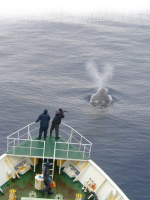
The IDCR-SOWER was a truly international research program organized by the IWC SC through a Steering Group. Design and implementation of each survey was responsibility of the IWC SC who was in charge to identify and invite the appropriate international scientists for each survey (apart from scientists provided by some member government such as Japan and the former Soviet Union). Usually, 3-4 scientists worked onboard each vessel (Figure 1).
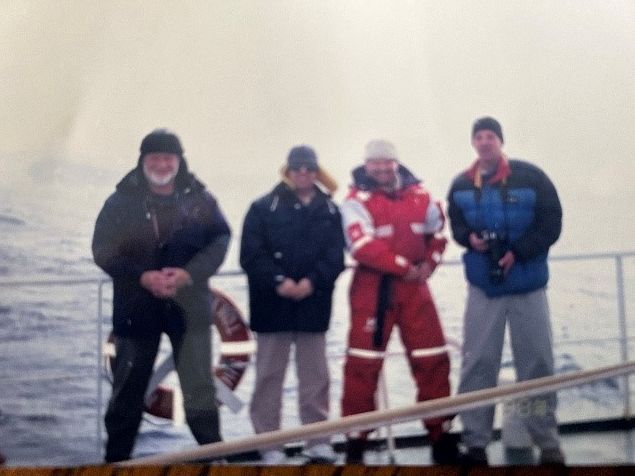
Figure 1. Scientists participating in the 1997/98 IWC SOWER cruise in Area II on board the research vessel Shonan Maru No. 2.
The IDCR-SOWER was conducted for more than 30 years including the three complete circumnavigations of the Southern Ocean mentioned above. A total of 86 scientists from 16 member nations participated in those surveys.