The Institute of Cetacean Research


Completion of the 2026 IWC/Japan Joint Cetacean Sighting Survey Cruise in the North Pacific
- IWC POWER
September 29, 2026
Designated Corporation for Scientific Whale Research
THE INSTITUTE OF CETACEAN RESEARCH
1. Background
This survey is conducted jointly by the International Whaling Commission (IWC) and Japan and is commonly referred to within the IWC as IWC-POWER (International Whaling Commission/Pacific Ocean Whale and Ecosystem Research). IWC-POWER is the successor of IWC/SOWER (International Whaling Commission Southern Ocean Whale and Ecosystem Research), a successful whale research program acclaimed globally, which was conducted in the Antarctic Ocean from 1996/1997 to 2009/2010. Taking advantage of the know-how, experience and achievements of IWC/SOWER, IWC-POWER has been carried out every summer since 2010 based on the main research plan of the IWC Scientific Committee.
The 16-year period of surveys from 2010 to 2025 was designated as IWC-POWER Phase I (Short-Term Programme) and was conducted mainly across a wide area of the North Pacific. In an area where extensive whale sighting surveys had not been conducted for several decades, numerous sightings of fin whales, sei whales, Bryde’s whales, sperm whales, and other species were recorded during these 16 years. In addition, information on the distribution of rare species, including blue whales and North Pacific right whales, was obtained. In the Chukchi Sea of the Arctic Ocean, an area where there had been a gap in genetic sampling, numerous biopsy samples from gray whales were collected. With these and many other achievements, Phase I was completed. The data collected provide a basis for objective stock assessments of large whales in the North Pacific.
Building on the results of Phase I, this 17th survey cruise was designated as the first year of Phase II (medium- to long-term plan) of the IWC-POWER program. Based on discussions by the IWC Scientific Committee’s Technical Advisory Group (TAG), Phase II aims to further develop objective stock assessments that contribute to the management and conservation of large whales in the North Pacific. This year’s survey was conducted in the high seas of the northeastern Pacific north of 40°N and between 155°W and 135°W. A survey was also conducted in this area in 2021. A total of four international researchers participated in the survey: two from Japan, one from the United States, and one from the Republic of Korea. The survey was conducted from July 17 to October 5.
2. Outline of the 2026 Research Cruise
This sighting survey cruise was conducted collaboratively by the IWC and the Government of Japan, with the IWC Scientific Committee developing the plan. The IWC-POWER Steering Group established within the IWC Scientific Committee (Convenor: Koji Matsuoka, Institute of Cetacean Research) led the planning and implementation of the survey. The survey was commissioned to the Institute of Cetacean Research by the Fisheries Agency of Japan and was conducted in cooperation with relevant research institutions, including Tokyo University of Marine Science and Technology and the U.S. National Oceanic and Atmospheric Administration / Alaska Fisheries Science Center (NOAA/AFSC).
2.1 Main objectives
(1) Collection of information for the in-depth stock assessment of humpback whales./p>
(2) Collection of data on distribution and stock structure of the rare blue whale and North Pacific right whale.
(3) Collection of data on abundance and stock structure of other whale resources with insufficient resource information.
(4) Collection of basic information, including oceanographic (sea water temperature, marine debris, etc.) necessary for the development of the medium- to long-term plan of this research program.
(5) Collection of information from areas affected by the marine heatwave (“The Blob”, 2014–2016)./p>
2.2 Research Cruise Period
From July 17 to October 5, 2026 (81 days).
2.3 Research Area
The survey was conducted in the high seas between 155°W and 135°W north of 40°N (Figure 1). The research vessel called at the Port of Kodiak, Alaska, to embark and disembark the U.S. researcher and to load and unload survey equipment and materials.
2.4 International Researchers
The survey was conducted by the following international researchers appointed by the IWC Scientific Committee.
Taiki Katsumata (Cruise leader, Institute of Cetacean Research, Japan)
Bernardo Alps (IWC-nominated international researcher, USA)
In-Woo Han (Cetacean Research Institute, National Institute of Fisheries Science, Republic of Korea)
Hiyori Suzuki (IWC-nominated international researcher, Institute of Cetacean Research, Japan)
2.5 Research Vessel
Yushin-Maru No. 2 (Kyodo Senpaku, Ltd., 747 tons, Captain Shigeru Nojima, 16 crewmen).
3. Summary of Results
・ No humpback whales had previously been sighted in the survey area; however, more than 20 groups were sighted this year, providing new knowledge on the distribution of this species.
・ A total of 13 blue whale groups comprising 15 individuals were sighted. As the number of sightings exceeded that of the previous survey, the results suggest recovery of the stock.
・ Numerous fin whales and sei whales were sighted in the survey area.
・ For the whales sighted, photographs for individual identification were taken, biopsy samples (skin samples) were collected for DNA analysis, and satellite tags were attached to investigate diving behavior.
・ Future detailed analyses will enable comparisons with past surveys, and the data are expected to be utilized in research purposes such as evaluating the impact of marine heatwaves, analyzing stock trends, and detecting changes in distribution.
3.1 Total Distance Covered
1,526 nautical miles (approximately 2,826km).
3.2 Main whale sightings
Blue whale (13 groups, 15 animals), fin whale (66 groups, 116 animals), sei whale (50 groups, 122 animals), minke whale (1 group, 1 animal), humpback whale (26 groups, 40 animals), sperm whale (24 groups, 32 animals), killer whale (2 groups, 14 animals).
3.3 Results of sample collection and other experiments
(1) Photo identification data (number of individuals)
Blue whale (12 animals), fin whale (30 animals), sei whale (63 animals), humpback whale (14 animals), killer whale (11 animals).
(2) Collection of biopsy samples (number of animals)
Blue whale (5 animals), fin whale (2 animals), sei whale (7 animals), humpback whale (1 animal).
(3) Satellite tag attachment (number of individuals)
Sei whale (2 animals).
(4) Marine debris (number observed)
We recorded 68 cases of marine debris in the research area.
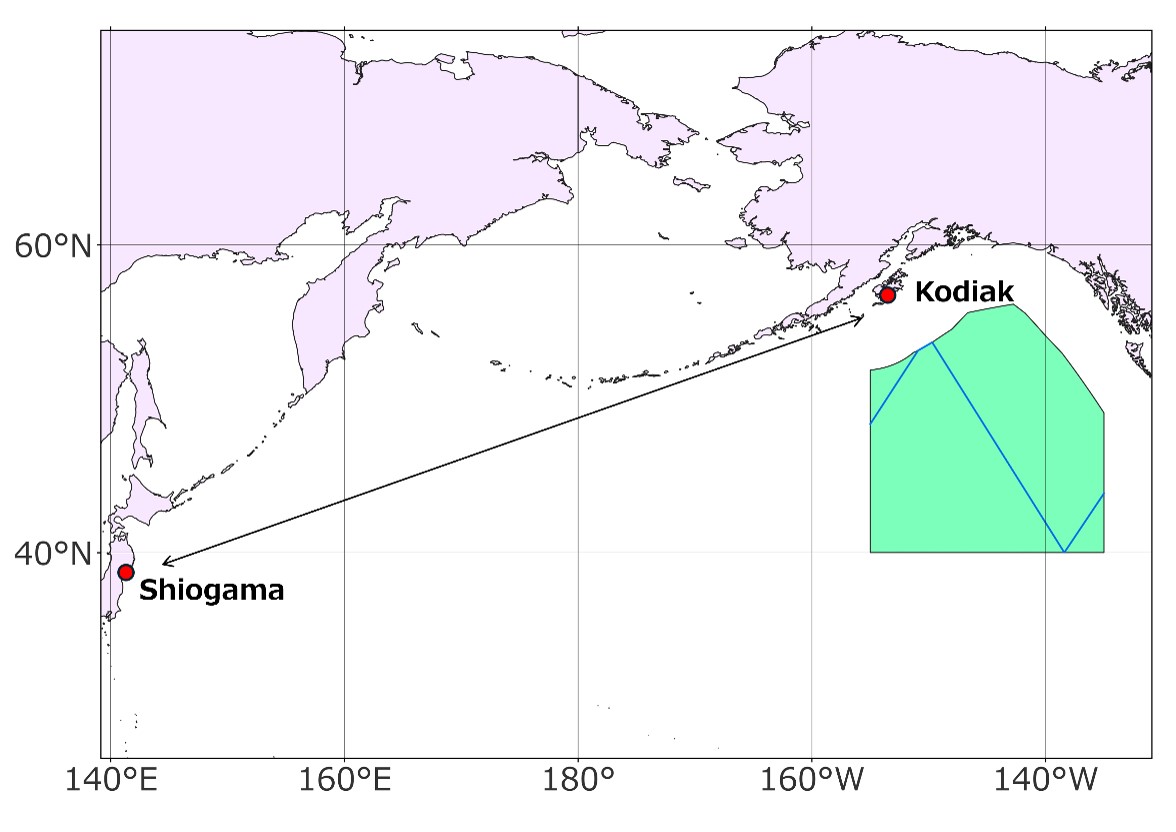
Figure 1. 2026 IWC-POWER survey area (green area) and survey track line (blue line).
Photographs from the 2026 IWC-POWER cruise
 |
 |
|
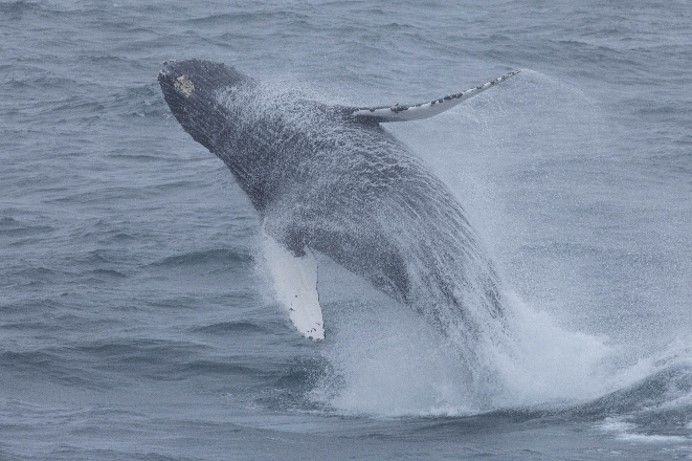
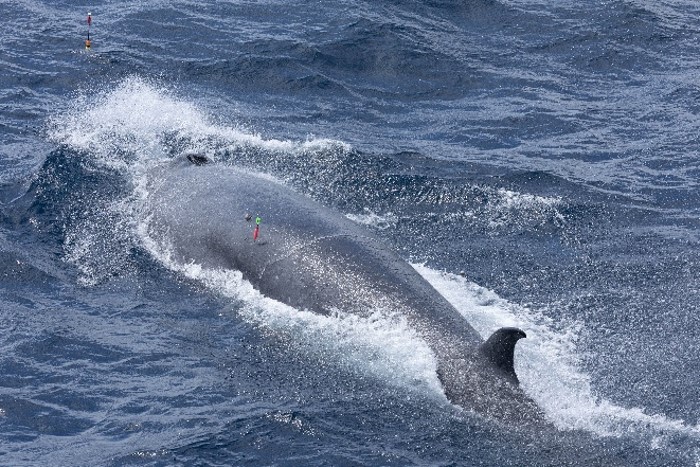
| Breaching humpback whale. | Sei whale fitted with a satellite tag. | |
 |
 |
|
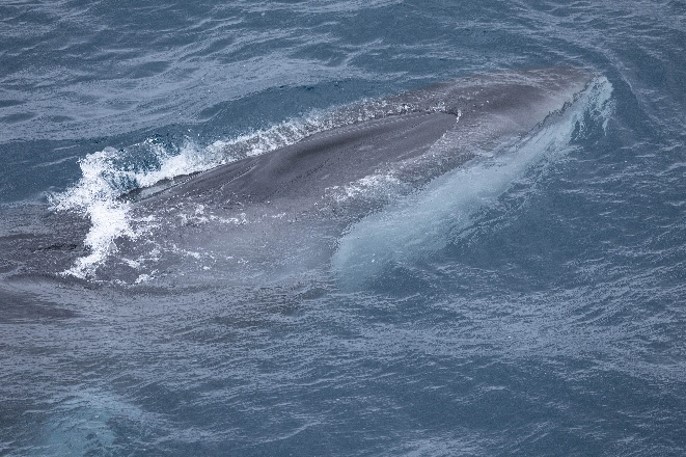
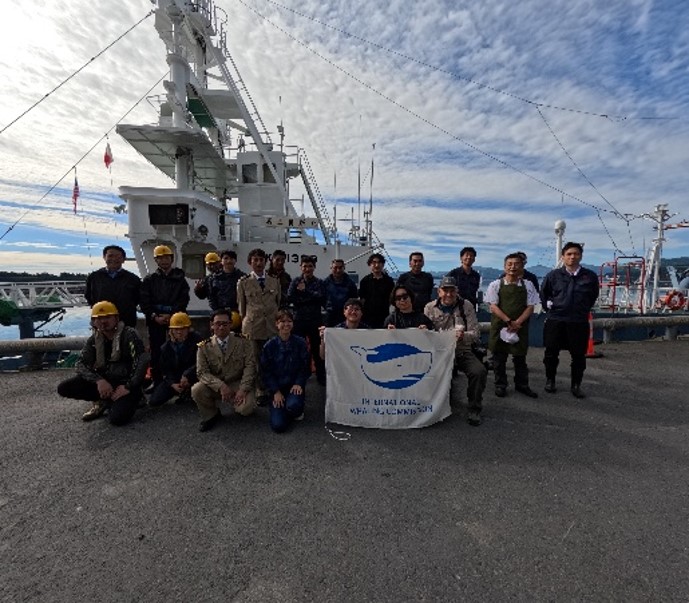
| A fin whale surfacing to breathe. | International researchers and crew (Kodiak Harbor). | |
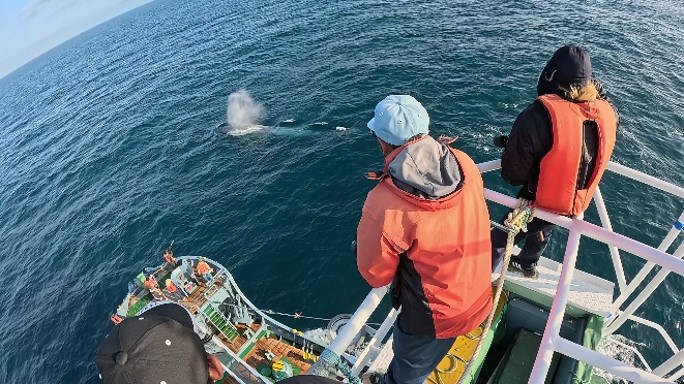 |
Blue whale biopsy specimen collection. |
Completion of the 2026 IWC/Japan Joint Cetacean Sighting Survey Cruise in the North Pacific - IWC-POWER (PDF file)