The Institute of Cetacean Research

- You are here:
- Home>
- English Sitemap>
- RESEARCH>
- Ongoing Research>
- Market Monitoring Survey





Market Monitoring Survey
As in the case of Norway and Iceland, Japan has been using a DNA-based system for monitoring (tracking origins of) large whale products sold in the retail market (Figure 1). Such a task is entrusted to the Institute of Cetacean Research (ICR) by the Government of Japan (Fisheries Agency of Japan, FAJ) as an outsourced program every year.
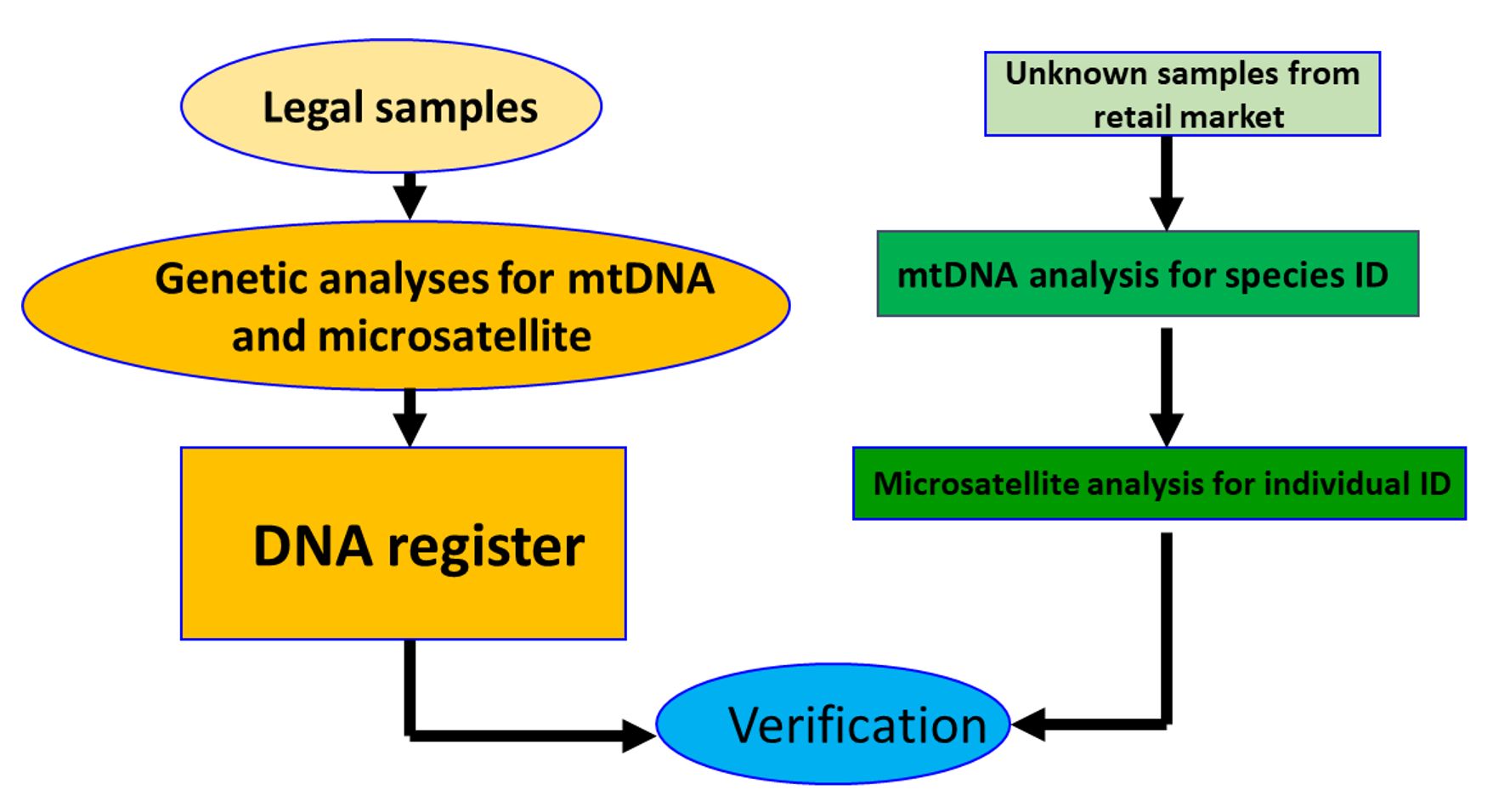
Figure 1. Flow chart of the DNA monitoring system of large whale products sold in the Japanese retail market.
The system is composed of two main components(Figure1), i) a DNA register including genetic profiles of all large whales legally taken in Japan (including bycatches) and imported into Japan, and ii) systematic surveys of large whale products sold in the retail market. The objective of this program is to prevent illegal take of large whales and illegal import of large whale products by comparing DNA profiles of large whale products obtained in the market with those filed in the DNA register.
The Japanese DNA register (JDR) contains DNA profiles of large whales sampled from different sources:
i) Former special permit whale research programs in the Antarctic (JARPA/JARPAII and NEWREP-A). This category includes Antarctic minke whales caught between 1987/88 and 2018/19, and fin whales between 2005/06 and 2011/12.
ii) Former special permit whale research programs in the western North Pacific (JARPN/JARPNII and NEWREP-NP). This category includes common minke whales caught between 1994 and 2019; Bryde's whales between 2000 and 2019; sei whales between 2002 and 2019; and sperm whales between 2000 and 2013.
iii) Commercial whaling within Japan’s Exclusive Economic Zone (EEZ). This category includes common minke, Bryde’s, sei and fin whales caught since 2019.
iv) Bycatches in set nets, mainly common minke whales (register system established since 1 July 2001).
v) Imports. This category includes North Atlantic common minke whales from Norway and North Atlantic fin whales from Iceland since 2008.
In the cases of special permit whale research programs and current commercial whaling, samples for genetic analysis have been collected by researchers from each caught whale. In addition, a large amount of information was collected using established protocols from every whale sampled including species, catch date and location (longitude, latitude), body length, sex and maturity status.
In the case of bycatches, frozen skin or muscle samples received from fisherman are used.
Regarding sampling in the market, one or two technicians, who are familiar with whale products and market operations, carry out the sampling of whale products at retail shops each year. On an annual basis, around 300~350 samples are collected throughout Japan. The sampling attempts to cover the whole Japanese archipelago, but the method of sampling is not a random procedure. The following information is collected for each whale product sample: kind of whale product, sampling locality, date, weight and price. Once sampled, the products are sent to the laboratory at ICR for genetic analysis.
Standard phylogenetic analyses of 'test' and 'type' mtDNA sequences are conducted to determine the species of the sampled whale products. Also, individual identification is made through the analysis of microsatellite DNA(msDNA). Results of the comparisons between 'test' and 'type' samples are summarized in the annual report to the FAJ.
Considering results of the work obtained so far, it can be concluded that the DNA-based system is an effective tool for monitoring (tracking origins of) large whale products in the Japanese retail market.