The Institute of Cetacean Research
- You are here:
- Home>
- English Sitemap>
- RESEARCH>
- Ongoing Research>
- New Sighting Surveys


New Sighting Surveys
North Pacific
National dedicated sighting surveys
Japan, through the Fisheries Research Institute (FRI) conducted dedicated cetacean sighting surveys in the western North Pacific since the 1980's with the main purpose of estimating the abundance of different species of large whales. Since 1995 the Institute of Cetacean Research (ICR) continued the implementation of dedicated sighting surveys as part of the Special Permit Whale Research Programs (SPWRPs). In this case abundance estimates were required for fulfilling some of the assessment and ecological-related research objectives of the SPWRPs.
Until 2019 Japan, through the ICR, worked closely with the International Whaling Commission's Scientific Committee (IWC SC) in the planning of the surveys as well as in the discussions of the results of the field and abundance estimates works. In fact, Japanese field and analytical works followed established guidelines developed by the IWC SC. Japan officially withdrew from the IWC on 30 June 2019. As an effect of this decision, the SPWRPs 'New Scientific Whale Research Program in the North Pacific' (NEWREP-NP) was halted by the Government of Japan (GOJ). In 2019 after Japan's withdrawn from the IWC, Japan through the ICR decided to continue the dedicated sighting surveys in the North Pacific following the IWC SC guidelines, under the rationale that the collection of sighting data to estimate abundance had contributed in the past to the work of IWC SC on conservation and management of large whales.
Apart from the main purpose of collecting sighting data for abundance estimates, the dedicated sighting vessels have been used as a platform for obtaining different kinds of data from whales and their environment.
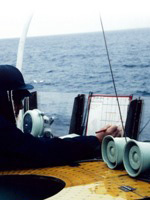
Figure 1 shows examples of specialized research vessels participating in Japanese dedicated sighting surveys in the central-western North Pacific, and examples of whale sightings along pre-determined track-lines.
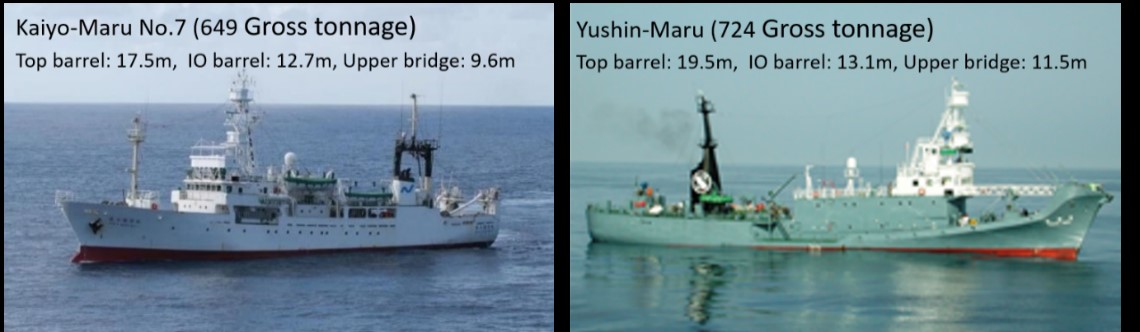
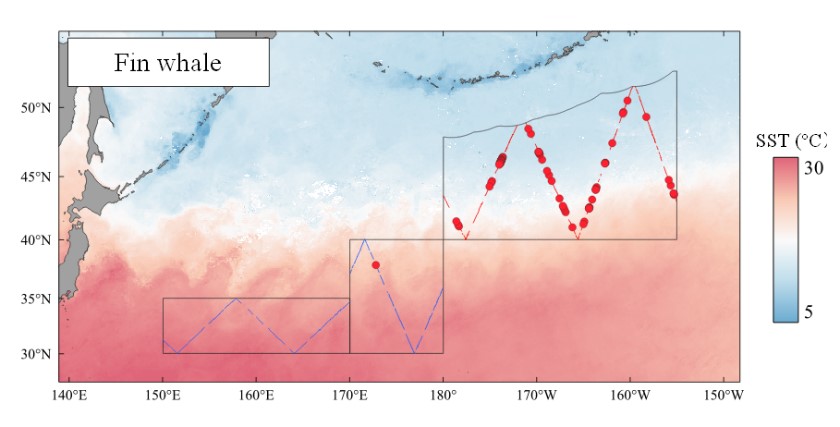
Figure 1. Dedicated sighting vessels (top) and example of sighting of fin whales (bottom) along the survey track-lines in the North Pacific sighting surveys.
Dedicated sighting surveys in the central-western North Pacific are conducted annually, mainly in spring-summer, in feeding grounds or migratory corridors of baleen whale species. The research area comprises waters in the central and western North Pacific, usually north of 30°N and west of 160°W.
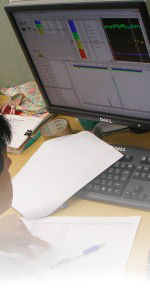
The specialized vessels engaged in the surveys are equipped with instruments and equipment required for collecting sighting data under the Line Transect Method, a method commonly used for estimating abundance in wild species, in this case baleen whale species. This is the main research activity of the surveys. Scientific personnel assisted by captain and crew members are also engaged in other research activities such as biopsy sampling for DNA studies on stock structure; photo-identification and satellite tracking for studies on distribution, movement and stock structure; oceanographic surveys to understand the environment of whales; and drone surveys to assist the counting of whales and for studies on photogrammetry.
Priority species of the dedicated sighting surveys in the central-western North Pacific are the target species of the Japanese commercial whaling in Japan's Exclusive Economic Zone (EEZ): common minke, Bryde's, sei and fin whales. Abundance estimate and stock structure are essential information for the application of management procedures aimed at calculating sutainable catch limits in these species. The surveys collect the same information for other non-exploited species, e.g. North Pacific blue, humpback and right whales, and in these cases, information on abundance and stock structure is important to monitoring their status and abundance trends.
Usually, 2-3 experienced researchers from the ICR participate in the dedicated sighting surveys in the central-western North Pacific, which are assisted by experienced captains and crew members.