The Institute of Cetacean Research
- You are here:
- Home>
- English Sitemap>
- RESEARCH>
- Ongoing Research>
- Biological Survey


Biological Survey
Biological survey in commercial whaling
Japan authorizes limited commercial whaling within its Exclusive Economic Zone (EEZ) for four baleen whale species: common minke, sei, Bryde’s and fin whales. An ad-hoc domestic group composed by scientists from several Japanese research organizations and officials from the Fisheries Agency of Japan (FAJ) was established in 2019 with the aim to carrying out the calculations of catch limits for those species in line with the International Whaling Commission (IWC)’s Revised Management Procedure (RMP). Catch limits calculated by the domestic group are reviewed by a team of international experts. Final catch quotas are then determined by the FAJ based on the results of the domestic group reviewed by the international team.
Japan's work on catch limits (including the Implementation Simulation Trials, ISTs to examine uncertainties in the calculation of catch limits) is based on the best available science; hence the catch limits will be revised from time to time to reflect the latest scientific information. New samples and data for analyses focused on updating catch limit calculations come mainly from dedicated sighting surveys (e.g. abundance from sighting surveys and stock structure from genetic analyses of biopsy samples), and from biological data and samples from the whales taken by current commercia whaling.
Regarding the latter, scientists from the Institute of Cetacean Research (ICR) participate in each of the Japanese commercial whaling campaign to collect data and biological samples from the catches. This research activity is carried out to monitor the exploited stocks through the analysis of some biological parameters and to improve the specification of the scenarios to be considered in future ISTs. The key information collected from the catches are catch date and location, sex and body length (basic); photographic record for external body characters, body scar record, external body proportion and skin tissue (stock structure); earplugs, eye lens and baleen plates (age determination); ovaries, testis, foetus (reproductive status); blubber thickness, stomach contents and other internal tissues (ecological monitoring).
One or two scientists from the ICR participate in whaling campaigns, either working at land stations (common minke whale) (Figure 1) or at whaling vessels (sei, Bryde’s and fin whales) (Figure 2). Campaigns are carried out usually in the spring-summer seasons.
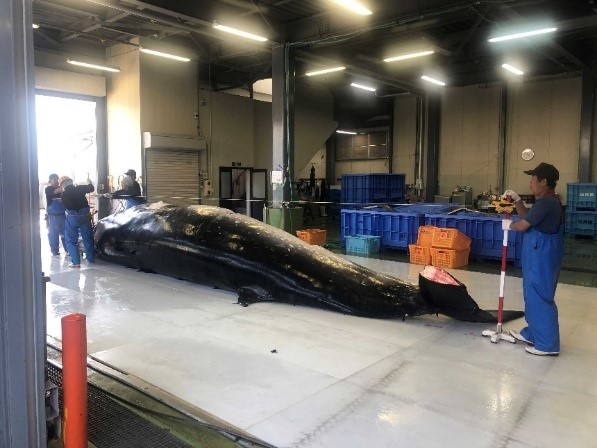
Figure 1. ICR scientists collecting biological data from a common minke whale at a land whaling station (coastal commercial whaling).
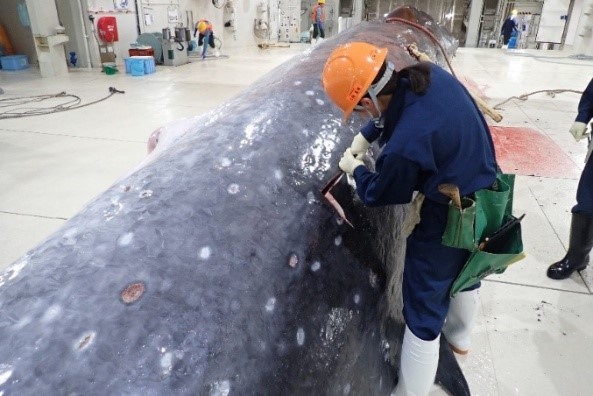
Figure 2. ICR scientists collecting biological data from a Bryde’s whale on board a whaling vessel (pelagic commercial whaling).